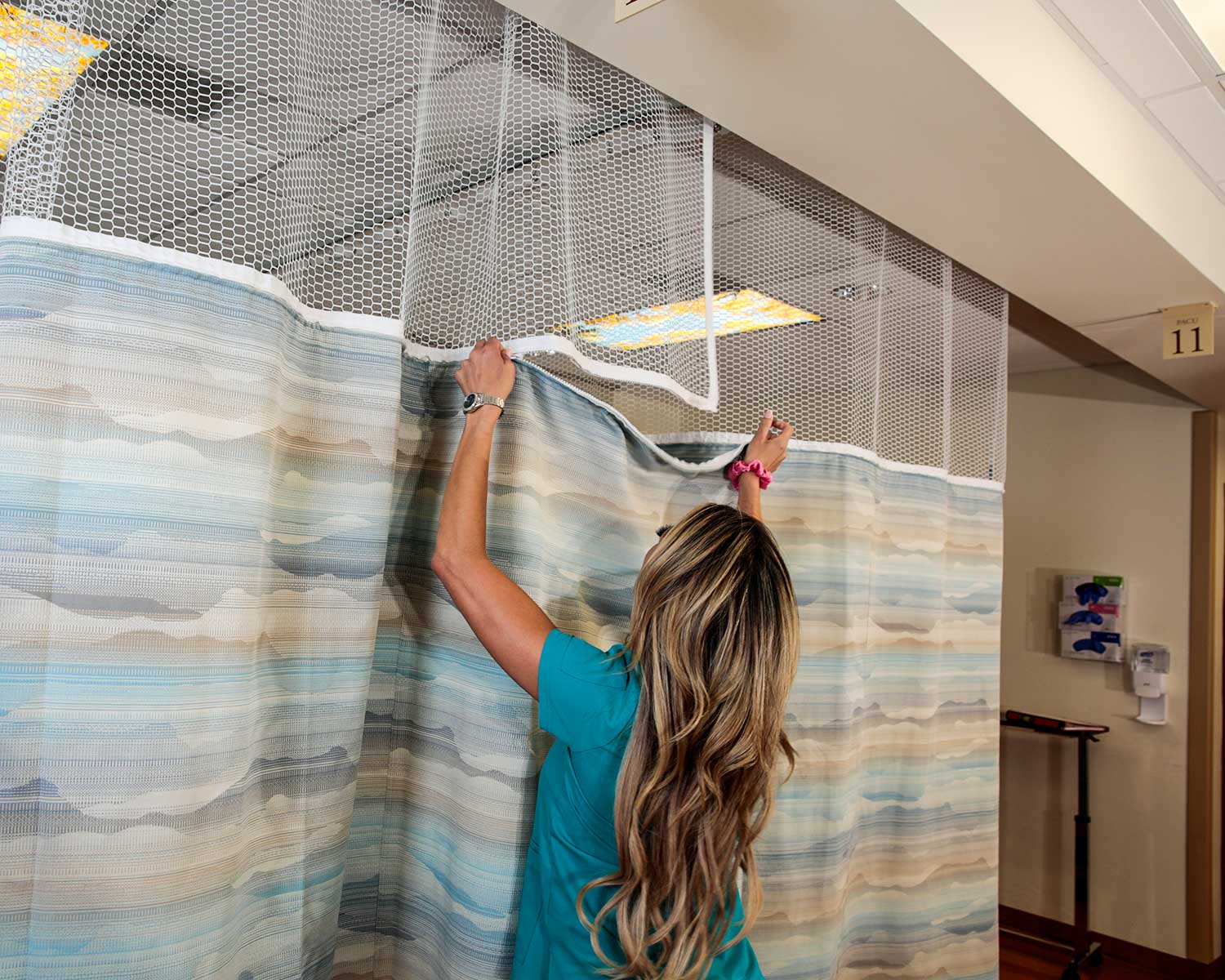
In today’s healthcare environment, infection prevention extends far beyond hand hygiene and surface disinfection. One of the most frequently touched — yet historically overlooked — items in patient rooms is the hospital privacy curtain. As hospitals continue to combat healthcare-acquired infections (HAIs), increasing the frequency of privacy curtain cleaning has become a proven, evidence-based strategy to protect patients, staff, and visitors.
Privacy Curtains: A Hidden Infection Risk in Patient Rooms
Hospital privacy curtains are handled repeatedly throughout the day by nurses, physicians, patients, and visitors. Despite this high contact rate, curtains are often cleaned far less frequently than other high-touch surfaces.
Multiple infection-control studies have shown that hospital privacy curtains can become contaminated within days of installation and may serve as vectors for pathogen transmission when not cleaned and disinfected on a routine schedule. This risk is well documented by the Centers for Disease Control and Prevention, which identifies environmental surfaces and shared textiles as contributors to healthcare-associated infections.
Authoritative resources:
- CDC – Healthcare-Associated Infections (HAIs):
https://www.cdc.gov/healthcare-associated-infections - CDC – Guidelines for Environmental Infection Control in Healthcare Facilities:
https://www.cdc.gov/infectioncontrol/guidelines/environmental
Without a structured curtain-cleaning program, privacy curtains can quietly undermine even the most robust infection-prevention initiatives.
Increased Curtain Cleaning Frequency = Reduced Infection Risk
Routine, scheduled privacy curtain cleaning significantly reduces microbial load and cross-contamination between patients and care teams. Rather than waiting for visible soiling or isolation events, hospitals that implement preventative curtain-cleaning schedules benefit from:
- Reduced pathogen transmission risk
- Improved infection-control compliance
- Stronger performance during regulatory audits
- Fewer emergency curtain changes during outbreaks
The World Health Organization emphasizes that consistent environmental hygiene — including textiles in patient care areas — is essential to reducing infection spread and maintaining patient safety.
Supporting guidance:
- WHO – Infection Prevention and Control:
https://www.who.int/teams/integrated-health-services/infection-prevention-control - WHO – Clean Care Is Safer Care:
https://www.who.int/initiatives/clean-care-is-safer-care
Increased cleaning frequency transforms privacy curtains from an infection liability into a controlled, manageable component of the patient environment.
Simplifying Curtain Changes Improves Staff Compliance
One of the most common obstacles to frequent privacy curtain cleaning is staff resistance — not due to unwillingness, but due to time constraints and physical difficulty. Traditional curtain systems often require ladders, time determining and locating correct replacement sizes, and multiple staff members, increasing room downtime and disrupting care.
Clinical research published in the American Journal of Infection Control demonstrates that healthcare workers are significantly more compliant with infection-prevention measures when workflows are simplified and physical strain is reduced.
Reference:
- American Journal of Infection Control (AJIC):
https://www.journals.elsevier.com/american-journal-of-infection-control
When curtain changes are faster and easier, compliance increases naturally — without additional enforcement or workflow disruption.
Operational Efficiency Meets Infection Control
Hospitals that modernize privacy curtain-cleaning programs experience measurable operational benefits, including:
- Faster patient-room turnover
- Reduced interruption to clinical workflows
- Lower staff injury risk
- Predictable, audit-ready documentation
Accrediting bodies reinforce the importance of environmental hygiene and consistency. The Joint Commission identifies environmental cleanliness, workflow efficiency, and documented infection-prevention practices as key elements of survey readiness.
Relevant guidance:
- The Joint Commission – Infection Prevention and Control:
https://www.jointcommission.org/resources/patient-safety-topics/infection-prevention-and-control/
By integrating curtain maintenance into routine environmental services schedules, hospitals achieve stronger infection control without increasing labor burden.
Why Hospitals Trust KEMTEX
KEMTEX specializes exclusively in hospital privacy curtain cleaning and infection-control solutions. With decades of experience supporting hospitals and healthcare systems nationwide, KEMTEX programs are designed to align with CDC, WHO, and Joint Commission best practices.
KEMTEX focuses on:
- Increased curtain-cleaning frequency
- Simplified curtain-change processes
- Reduced staff resistance and downtime
- Consistent compliance with infection-control standards
By addressing both hygiene and operational efficiency, KEMTEX helps hospitals lower infection risk while improving day-to-day performance.
Final Thoughts
Privacy curtains should never be the weak link in a hospital’s infection-prevention strategy. Increasing cleaning frequency — combined with easier, faster curtain changes — delivers measurable improvements in patient safety, staff compliance, and operational efficiency.
For hospitals committed to reducing healthcare-associated infections and maintaining the highest standards of care, proactive privacy curtain management is no longer optional — it is essential.

- Serving 75% of hospitals in Dallas–Fort Worth
- In compliance with CDC & Joint Commission Infection Protocols
- 49 Years Experience in Healthcare